10.3.15

Gulu on Holiday


So Gulu.

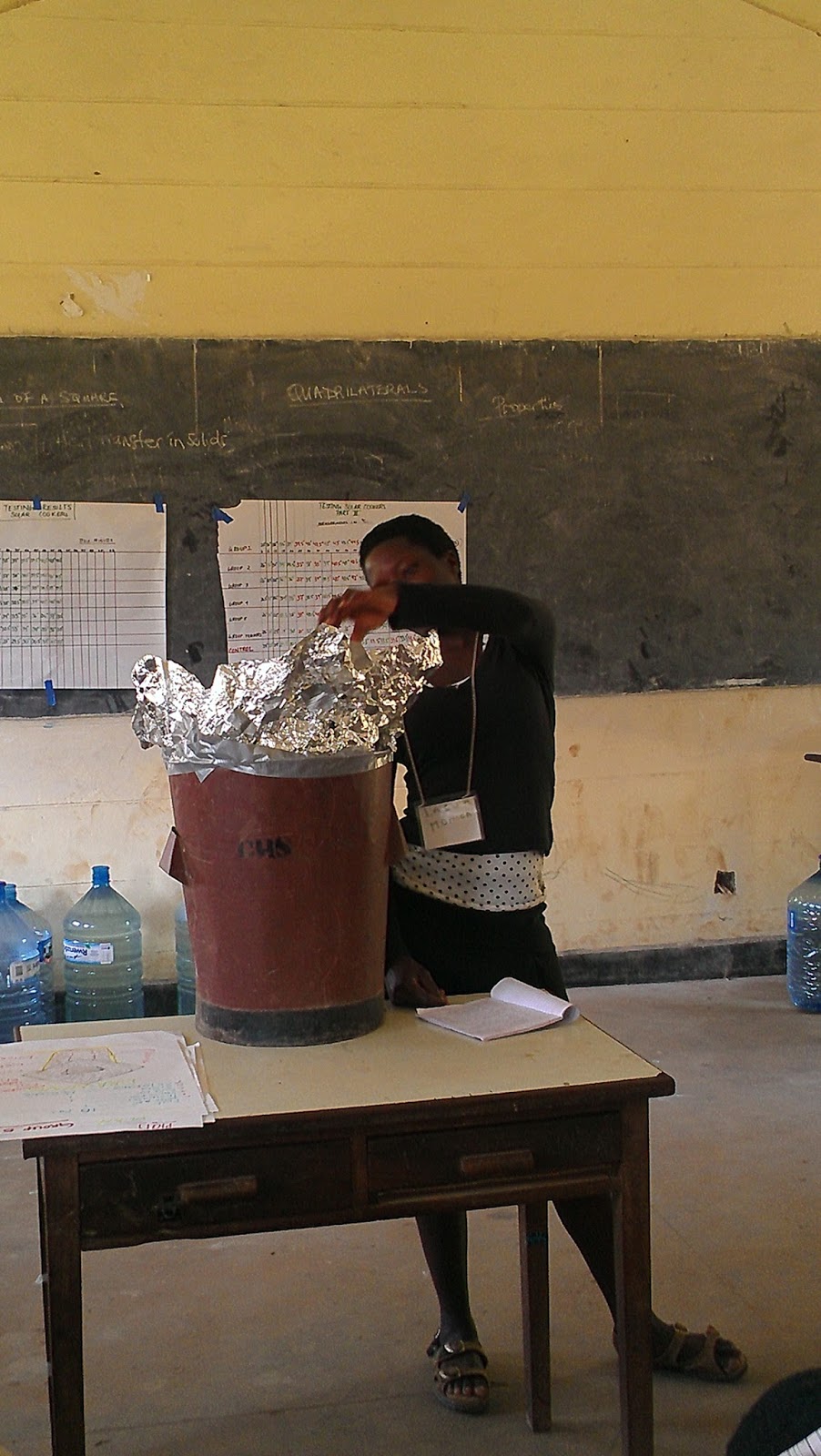
Over the long term break (basically December - January) I helped out at a high school girls' engineering camp in Gulu! This camp is sponsored by an American organization which has been coming to Uganda for a while. I was invited by one of my RPCV friends who was coming back to UG just to do this camp for two weeks. The first week focused on water filtration and purification, and the second week focused on solar cookers. I was working with two other women, Aarthi and Erin, who work in the STEM field, which was wonderful and empowering for the girls we were working with. We also had help from two male Ugandan teachers, Chris and Kennedy.


The beginnings of class.
After some introductory lessons, we asked the girls to build towers which had to meet certain requirements. Their materials were index cards, tape, and binder clips.


Cost calculations for water filters. 


Clay balls to remove bad smells and color.


Erin and Aarthi work on their filter!


Filter made by yours truly and my fellow PCV Jay.


Indian dinner night!


The teams line up for judging day. The judges taste their water and grade them on it.


The time keeper!


Presentations!


For solar cookers, we first took the temperature of the water in the shade to get our baseline.


More presentations!


Our girls spoke about their projects in front of the other camp participants, (there were robotics classes, and a group of blind students who did presentations) as well as in front of their families.


4.12.14

A Taxi Driver on his Death

A Taxi Driver on his Death

When with prophetic eye I peer into the future
I see that I shall perish upon this road
Driving men that I do not know.
This metallic monster that now I dictate,
This docile elaborate horse,
That in silence seems to simmer and strain,
Shall surely revolt some tempting day.
Thus I shall die; not that I care
For any man’s journey,
Nor for proprietor’s gain,
Nor yet for love of my own.
Not for these do I attempt the forbidden limits,
For these defy the traffic-man and the cold cell,
Risking everything for the little, little more.
They shall say, I know, who pick up my bones,
“Poor chap, another victim to the ruthless machine”—
Concealing my blood under the metal.


-Timothy Wangusa, A Pattern of Dust: Selected Poems 1965-1990

Mr. Wangusa speaks of the unfortunate commonality of traffic accidents in Uganda (as well as other developing countries). Though drivers have licenses, they often speed (here called ‘overspeeding’), get too close to motorcycles and pedestrians, or drive too harshly on very badly maintained roads. They pack entirely too many people/chickens/bags into their cars to get as much money as possible. And they do not really make enough money to have a decent living.

Taxi drivers are a necessity in a country with no public transportation and a dearth of people who know how to drive. A taxi in this sense is a car/van which has been licensed to get people back and forth. Rurally, they operate between smaller towns/trading centers. In larger cities, they can be there just to transport you around the town. This is most commonly seen in the capital city, Kampala.
I have not seen  a single woman taxi driver, though I have seen women driving private cars. My guess is that it’s a traditionally male occupation, like many other things, and in rural areas it would be unthinkable for men to be driven around by women.

The end of this poem is really sad to me, because what is he even driving the taxi for? If not money or love of driving, he’s maybe just doing it for something to do. To make the time go by. And when he dies he is just another cog in the machine, his sacrifice of a life concealed by the metal. It reminds me of how we treat service workers in America - they are just faces in the larger machine, without lives of their own.

You can read more about Timothy Wangusa here:


you can listen to him here:

http://badilishapoetry.com/timothy-wangusa/

and you can buy one of his books here:

Upon This Mountain - his novel
http://www.amazon.com/Upon-This-Mountain-African-Writers/dp/0435905422/ref=sr_1_1?ie=UTF8&qid=1417714859&sr=8-1&keywords=timothy+wangusa

He released another poetry collection, Africa's New Brood: 1985-2003, which I've been unable to find online, so my guess is it's only in local presses.

The book I'm using, A Pattern of Dust, retails for around $200 in all the places I could find (possibly out of print??) so I'm not going to recommend you buy that one. I honestly have no idea how I got it so cheap.


NOTE: I am making no money or profit from the posting of this work and will comply if Mr. Wangusa does not wish it to remain here.

20.11.14

Just

I'm starting a poetry series which will by no means be on any sort of schedule. I plan to post poetry of my own and poetry from some Ugandan poets who I've managed to find, and then discuss inspirations, related topics, etc. Hopefully I'm getting up 2-3 poems per month along with posts on other things. Enjoy.


Just.

the world is really too big
and too small.
all our conflicts springing up
and being shot down,
blown up,
or otherwise imploding.
how can someone take it in?
when do you start caring?
500,000?
1,000,000?
when do you stop?

here it seems a fact of life
that conflict is like a
neighbor who is always
loud and frowning.
he is ever around the
corner,
just on the veranda,
just there in the
trading center,
just there.


Part of this comes from talking with my fellow college tutors about the border insecurities in the region where I live. There was some small skirmishes between Sudanese settlers who are living in Uganda indefinitely, and the native Ugandan population. One of my tutors was talking about the ministry sending police/army to the region to settle things down.

It made me think that, especially in the North, with the history of the Lord’s Resistance Army, they are both used to the conflict – the older population, who is the minority – and not used to it – the younger population, the majority of whom were born at the end of or after the war. Conflict is the same in the Northeastern region of Uganda, where tribes who are traditionally cattle herders pretty much ignore modern borders and occasionally steal cattle and fight with other Ugandan natives there.

I think growing up in America, I always had that feeling that large groups of people were not going to riot or cause violence (at least in Michigan, I know other areas of the country have their own problems). I had a sense of security. Living in Uganda gives me a whole new appreciation of national security in terms of border security and legislating with native populations. And Uganda is mostly peaceful. I’m not trying to say that I am in danger or that Uganda is a dangerous place, but the fact that is it part of the cultural conversation as a normal thing is something new to me.


There are still refugee camps in Uganda for those from the Democratic Republic of Congo, and for those from South Sudan. Some of them are near me, some are fairly new. Some were just completely emptied not long ago, and are now full again.